
Melatonin for Sleep: What It May Help With and What to Consider
Melatonin is not a general sleeping pill. It is a hormone involved in the timing of the sleep-wake rhythm. This guide explains what it may help with, what remains uncertain, and what to check before choosing a product.
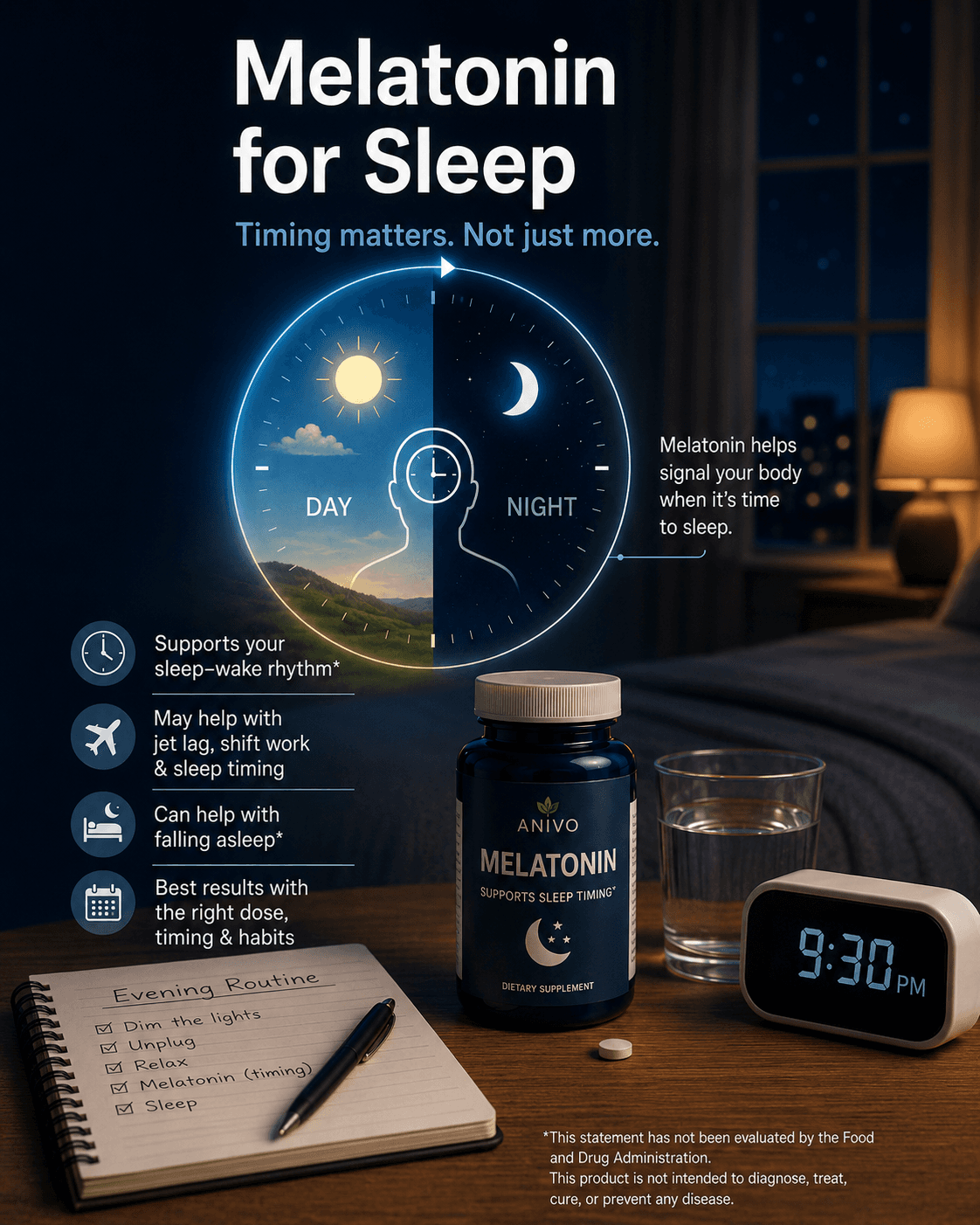
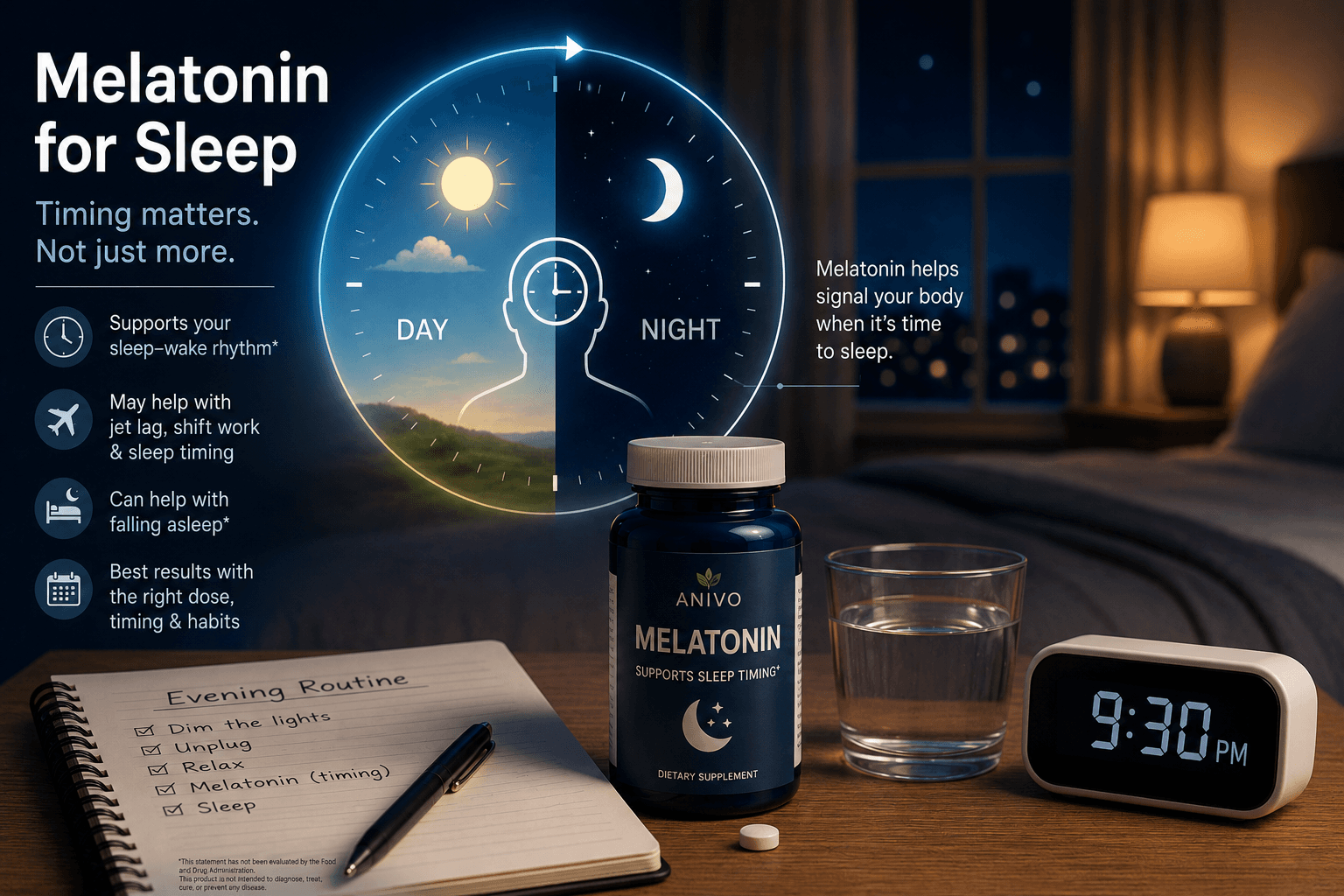
Before choosing a melatonin supplement, check: Why you are considering it · Sleep timing · Possible medication interactions · Age · Pregnancy or breastfeeding · Upcoming surgery · Product quality · Whether professional guidance is appropriate
Melatonin is one of the most familiar supplements associated with sleep.
It is often presented as a simple nighttime solution.
But melatonin is not the same as a general sleeping pill.
It is a hormone that the body naturally produces in response to darkness. Its main role is related to timing: helping the body recognize when it is night and supporting the sleep-wake rhythm.
That distinction matters.
What is melatonin?
Melatonin is a hormone produced naturally by the body.
Its production is linked to light and darkness.
As evening arrives and light levels decrease, melatonin levels typically rise. This helps signal that it is time to prepare for sleep.
Melatonin is connected to the body's circadian rhythm: the internal timing system that helps organize the sleep-wake cycle and other daily patterns.
Supplemental melatonin is intended to add an external signal.
Why melatonin is not a general sleeping pill
It is easy to think of melatonin as a natural sedative. That is not the most accurate way to understand it.
Melatonin does not work like a product designed to create a strong sedating effect.
It is better understood as a timing-related signal.
This is why it may be more relevant when the sleep schedule is out of sync than when sleep difficulty is caused by another issue.
For example, sleep problems may also relate to:
- stress
- inconsistent routines
- evening light exposure
- caffeine
- pain
- medications
- anxiety
- sleep apnea
- another health condition
What may melatonin help with?
Evidence is stronger in some situations than others. Common areas of discussion include:
- Jet lag — when travel crosses time zones, the body's internal clock may not match the local schedule. Some evidence suggests that melatonin may help with sleep problems related to jet lag. The details matter, including timing, direction of travel, and individual context.
- Delayed sleep timing — some people struggle to fall asleep until very late, even when they want to sleep earlier. Melatonin may be relevant when the goal is to shift sleep timing. This is different from using it as a general answer for every type of insomnia.
- Shift work and schedule disruption — people who work unusual schedules may find that their sleep window does not match the natural light-dark cycle. Melatonin is sometimes discussed as one possible tool. Timing and professional guidance matter.
- Difficulty falling asleep — some research suggests that melatonin may help some people fall asleep a little faster. But the effect is not universal and it should not be presented as a guaranteed solution or a cure for chronic insomnia.
What remains uncertain?
Melatonin is widely available, but that does not mean every use is well established.
Important uncertainties include:
- how useful it is for different types of sleep difficulty
- whether long-term nightly use is appropriate
- how product quality differs across brands
- how different amounts affect different people
- how age, health conditions, and medications change the decision
Why timing matters
Because melatonin is related to the body clock, timing is not a minor detail.
Taking it at the wrong time may be unhelpful or may shift sleep timing in an unintended direction.
That is why broad advice such as "take melatonin for sleep" is incomplete.
The more useful question is: "What sleep-timing problem am I trying to solve?"
More is not automatically better
A larger amount does not automatically create a better result.
Higher amounts may increase the chance of side effects without improving the outcome.
Avoid choosing a product only because the label displays a larger number.
Instead, focus on:
- why you are considering it
- whether the product clearly states the amount per serving
- whether professional guidance is appropriate
- whether the product uses transparent labelling
- whether you are also addressing sleep habits and evening light exposure
Possible side effects
Melatonin may cause side effects in some people.
Reported effects can include:
- headache
- dizziness
- daytime sleepiness
- nausea
- unusually vivid dreams
Children and teenagers require extra caution
Melatonin products, especially gummies, can look appealing to children.
They should be stored securely and kept out of reach.
Children and teenagers should not use melatonin without appropriate adult involvement and professional guidance.
Sleep problems in younger people deserve careful review rather than self-treatment.
Medication interactions and health considerations
Melatonin may interact with medications or be unsuitable in certain situations.
Professional guidance is especially important when:
- you take prescription or over-the-counter medications
- you have a medical condition
- you are pregnant or breastfeeding
- you are preparing for surgery
- you are considering melatonin for a child or teenager
- sleep problems are persistent or severe
What to check before buying
Before choosing a melatonin product, ask:
- Why am I considering melatonin? Is the issue related to sleep timing, travel, shift work, or a broader sleep problem?
- Is the amount clearly listed? Can I see the amount per serving and the serving size?
- Are the ingredients simple and transparent? Does the product avoid vague blends and unnecessary additions?
- Has product quality been independently checked? Is there reliable quality information?
- Could it interact with a medication or health condition? Would a doctor or pharmacist need to review the choice?
- Is this being stored safely? Is the product kept away from children?
- Am I also addressing light and routine? Have I considered evening light exposure, sleep timing, caffeine, and bedtime habits?
A calm buying rule
Do not treat melatonin as a shortcut for every sleep problem.
Treat it as a timing-related supplement that may be relevant in some situations.
Read the label. Keep expectations realistic. Store it safely.
Final thought
Melatonin is not about forcing the body to sleep.
It is about timing.
That is why it may be useful for some people and less useful for others.
The most responsible approach is not to ask: "Is melatonin good for sleep?"
Educational Disclaimer
This content is for informational and educational purposes only. It is not intended as medical advice and does not replace professional consultation. Always speak with a qualified healthcare provider before making changes to your health routine.
Sources & Further Reading
Product information is provided for educational comparison. Purchase links may be added later and may include affiliate links.
Related products
Explore products connected to this guide. Review the label, serving size, and key details before choosing.
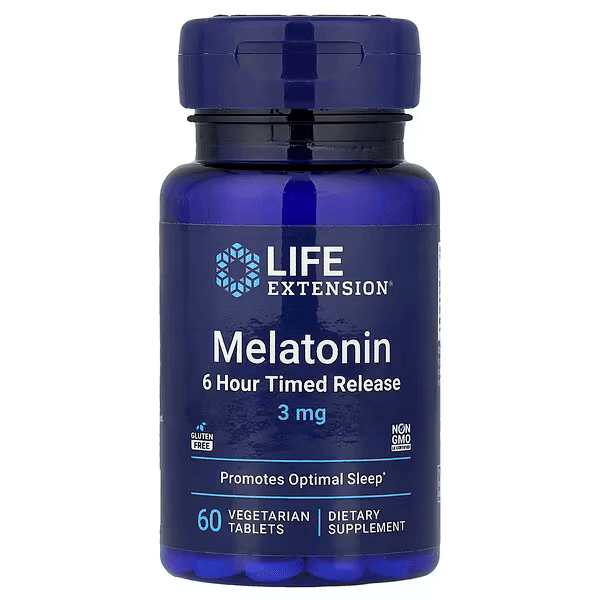
Life Extension
Melatonin, 6 Hour Timed Release, 3 mg
Timed-release melatonin 3 mg designed for a six-hour release profile.
- Format
- Vegetarian timed-release tablets
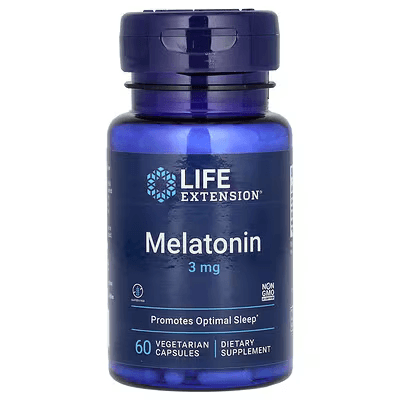
Life Extension
Melatonin, 3 mg
Melatonin 3 mg in vegetarian capsules.
- Format
- Vegetarian capsules
A Practice to Try
A short guided practice connected to this topic.
Nervous System Reset | Guided Breathwork
Beginner
A guided breathwork practice designed to help you explore short, intentional breathing patterns and return to a calmer state. This practice may support a sense of reset and nervous system awareness.
This practice is for educational purposes only and is not medical advice. If you feel unwell or have a medical condition, consult a qualified healthcare professional before starting any new practice.
Related Reading

A Beginner's Guide to Supplements: What to Know Before You Buy
The supplement aisle can feel confusing. This beginner-friendly guide explains what supplements are, why quality and safety matter, what to check on a label, and when to ask a healthcare professional for guidance.

Supplement Safety: What to Know About Interactions and Side Effects
Natural does not automatically mean risk-free. Dietary supplements can cause side effects, interact with medications, or be unsuitable in certain situations. This guide explains the basic safety checks to make before adding a new product.

Continue exploring
Discover guides, supplements, books, and practical resources for stress & mental balance.