
Why Your Heart Rate Changes When You Breathe
Your heart rate is not a steady metronome. This guide explains how breathing naturally changes the timing between heartbeats, what HRV and RSA mean, and why comfortable slow breathing may support regulation without chasing a perfect number.


Your heart does not beat like a metronome.
Even when you are sitting quietly, the timing between one heartbeat and the next is constantly changing.
Some of those changes happen because of movement, emotion, sleep, hydration, or physical effort. Others are closely connected to the way you breathe.
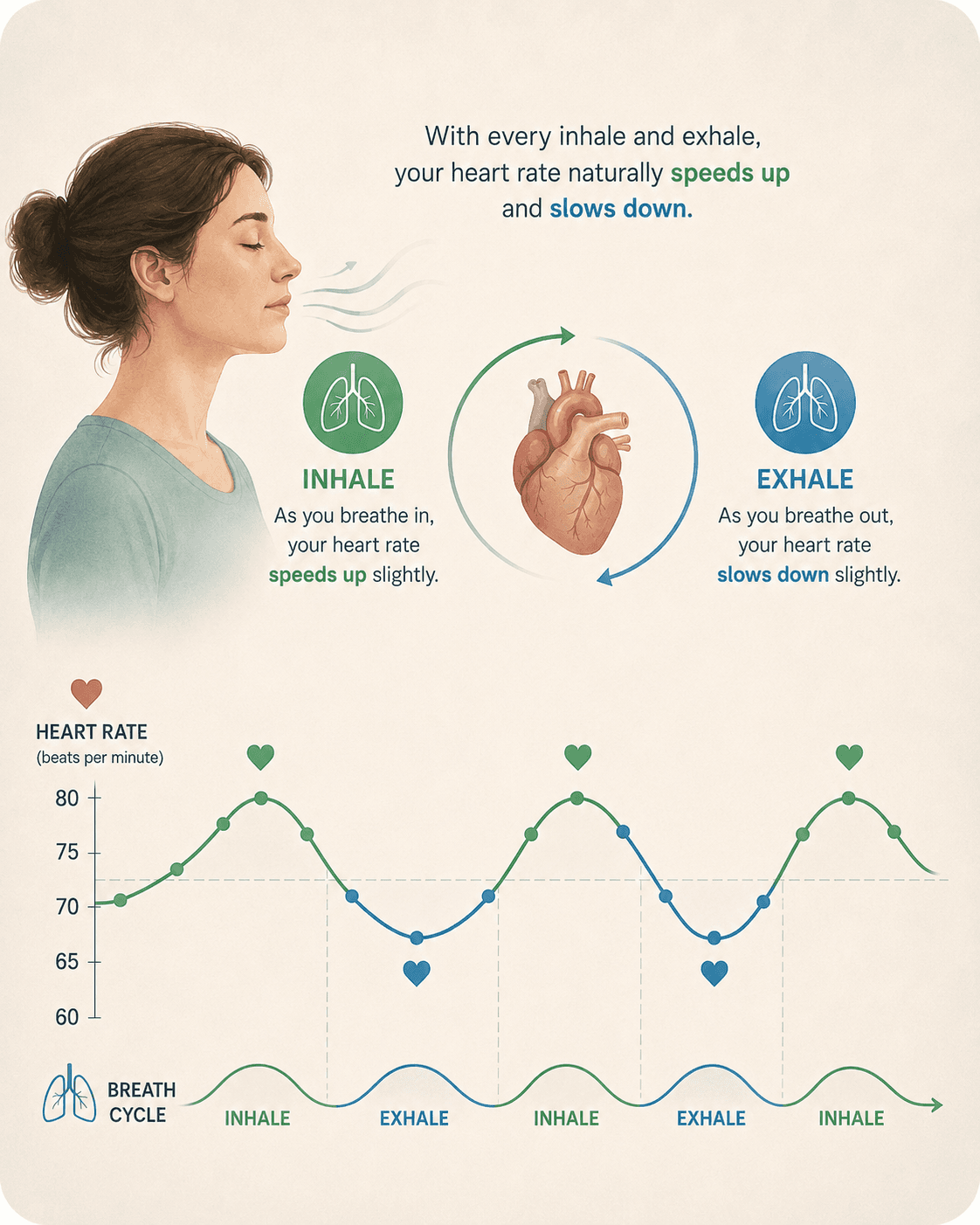
When you inhale, your heart rate often rises slightly.
When you exhale, it often falls slightly.
This natural rhythm is one reason breathing practices can influence how the body experiences stress.
The Heart Is Designed to Adapt
A perfectly fixed heart rate may sound ideal, but the body is not designed to stay locked into one rhythm.
Your heart is constantly responding to changing conditions.
It may speed up when you walk quickly, prepare for a difficult conversation, or feel surprised.
It may slow down when you rest or begin to recover after a demanding moment.
This flexibility matters more than any single number.
The body is always adjusting.
What Is Respiratory Sinus Arrhythmia?
The breathing-related rise and fall in heart rate is called Respiratory Sinus Arrhythmia, or RSA.
Despite the word "arrhythmia," RSA is usually a normal pattern.
It simply describes the way the heart rate tends to shift across the breath cycle:
- during inhalation, the heart rate often rises slightly
- during exhalation, the heart rate often falls slightly
What Is Heart Rate Variability?
Heart Rate Variability, or HRV, is a broader concept.
It refers to variation in the amount of time between heartbeats.
RSA contributes to HRV, but the two terms are not interchangeable.
HRV is influenced by many factors, including:
- age
- sleep
- physical activity
- hydration
- illness
- stress
- recovery
- time of day
How Slow Breathing Can Influence the Pattern
When breathing becomes slower and more comfortable, the rise and fall in heart rate across the breath cycle may become more noticeable.
Research suggests that slow-paced breathing can increase certain HRV measures, particularly those influenced by parasympathetic activity.
One reason is that breathing changes pressure inside the chest and interacts with the body's blood-pressure regulation systems.
This includes a feedback mechanism known as the baroreflex.
Is Six Breaths per Minute the Ideal Pace?
Many studies explore breathing at around five to six breaths per minute.
That usually means one full breath cycle every 10 to 12 seconds.
But this is not a universal target.
The most comfortable pace varies from person to person.
For some people, slowing down to six breaths per minute feels easy.
For others, it may feel strained or create a sense of air hunger.
Why This Matters During Stress
Stress can make breathing faster and less comfortable.
That may be useful if you need to act quickly.
But when the body stays in a rushed pattern while you are sitting still, the sensations themselves can become distracting.
You may notice:
- a racing heartbeat
- chest tightness
- shallow breathing
- a sense of restlessness
- difficulty settling down
A 3-Minute Heart-Breath Awareness Practice
This short practice is not about improving a score.
It is about noticing the natural connection between your breath and your heartbeat.
- 1. Sit comfortably. Choose a chair with support and let your shoulders relax.
- 2. Find your pulse. Place two fingers gently on your wrist. There is no need to press hard.
- 3. Breathe naturally. Spend a minute noticing the rhythm without trying to change it.
- 4. Observe the pattern. See whether your pulse feels slightly quicker during inhalation and slightly slower during exhalation.
- 5. Allow a quieter breath. Let the breath become a little slower and smoother, without taking large inhalations.
- 6. Avoid forcing a count. You may find a gentle rhythm naturally. There is no need to hit a specific number of breaths per minute.
- 7. Continue for 2 to 3 minutes.
- 8. Stop if needed. If you feel lightheadedness, discomfort, or a strong urge to breathe, stop the exercise and return to your natural breathing rhythm.
Safety Note
Breathing exercises should remain comfortable and unforced.
Breath work can support well-being, but it is not a substitute for medical care.
A Rhythm to Notice, Not Control
The heart and breath are closely connected.
That does not mean you need to control every beat or measure every change.
The most useful starting point is awareness.
Notice what happens when the breath becomes quieter.
Notice whether the body feels more settled.
Notice without trying to win.
The goal is not a perfect rhythm. It is a more comfortable one.
Educational Disclaimer
This content is for informational and educational purposes only. It is not intended as medical advice and does not replace professional consultation. Always speak with a qualified healthcare provider before making changes to your health routine.
Sources & Further Reading
- Laborde, S., et al. (2022). Effects of voluntary slow breathing on heart rate and heart rate variability: A systematic review and a meta-analysis.
- Steffen, P. R., et al. (2017). The Impact of Resonance Frequency Breathing on Measures of Heart Rate Variability, Blood Pressure, and Mood.
- Zaccaro, A., et al. (2018). How Breath-Control Can Change Your Life: A Systematic Review on Psycho-Physiological Correlates of Slow Breathing.
- Fincham, G. W., et al. (2023). Effect of breathwork on stress and mental health: A meta-analysis of randomised-controlled trials.
A Practice to Try
A short guided practice connected to this topic.
Nervous System Reset | Guided Breathwork
Beginner
A guided breathwork practice designed to help you explore short, intentional breathing patterns and return to a calmer state. This practice may support a sense of reset and nervous system awareness.
This practice is for educational purposes only and is not medical advice. If you feel unwell or have a medical condition, consult a qualified healthcare professional before starting any new practice.

Continue exploring
Discover guides, supplements, books, and practical resources for stress & mental balance.