
Evening Light and Melatonin: Why Your Screen Habits Matter
Evening light can affect the body's transition toward sleep. Learn how screens, brightness, and late-night content may shape your rest — and how to create a softer landing into the night.
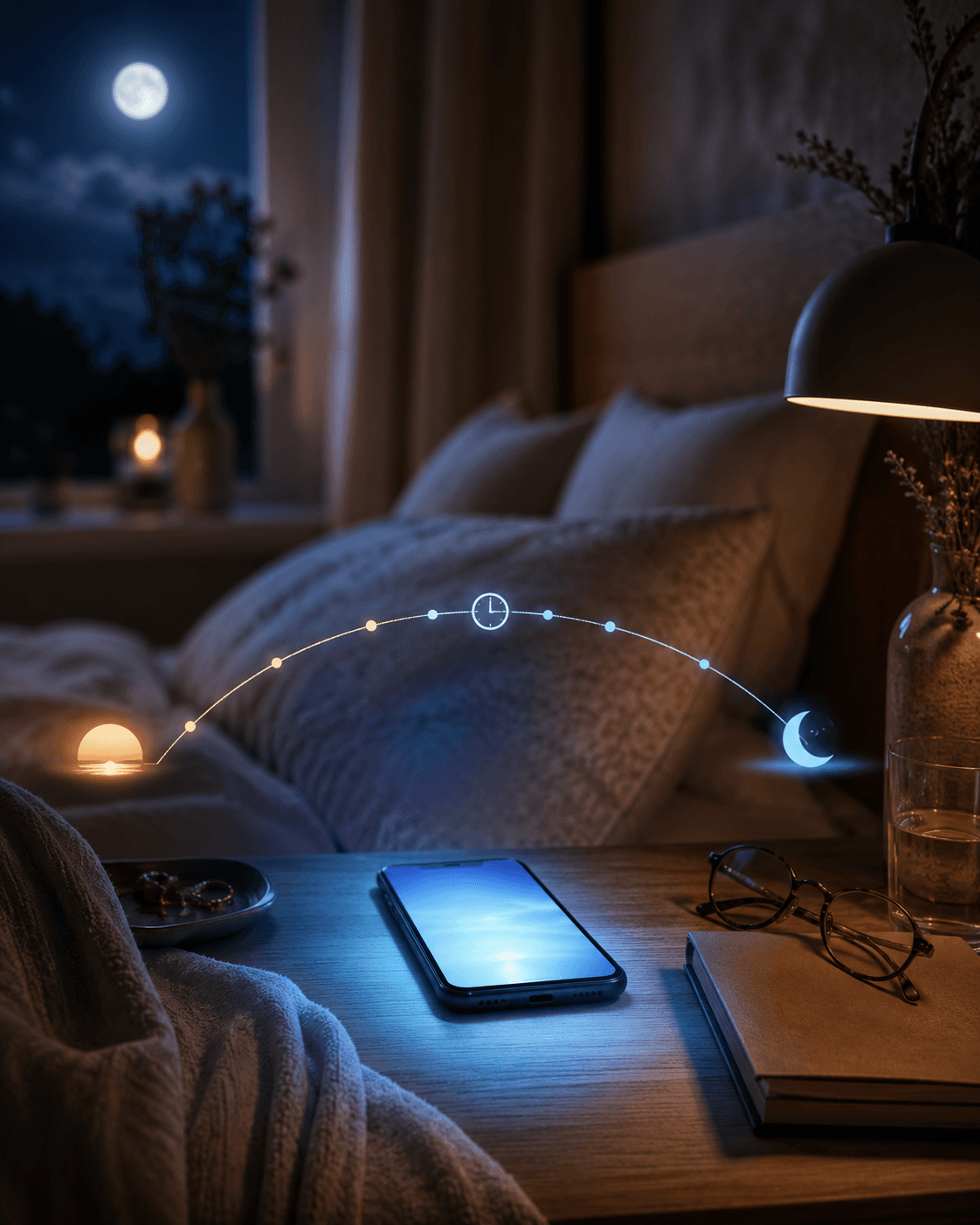
The day may be over, but the signals around us often say otherwise.
The room is still brightly lit. The phone is close by. One message leads to another. A quick scroll becomes another twenty minutes. The body may feel tired, but the environment still feels active.
For most of human history, the difference between day and night was much clearer. Light meant activity. Darkness meant slowing down.
Modern life has made that boundary less obvious. We can work, watch, read, shop, and communicate at almost any hour.
That flexibility is useful. But it also means the body may receive mixed signals at the exact moment it is trying to prepare for rest.
Understanding the relationship between evening light, screens, and melatonin is not about turning technology into an enemy. It is about creating a gentler transition from the pace of the day into the quiet of the night.
Light Helps the Body Understand Time
The body follows an internal rhythm that helps shape alertness and sleepiness across the day.
Light is one of the strongest signals that helps keep this rhythm aligned with the outside world.
During the day, brighter light supports alertness. As evening arrives and the environment becomes darker, the body receives a different message: the active part of the day is coming to an end.
This shift matters because sleep does not begin only when the head reaches the pillow.
The transition starts earlier.
Lighting, activity, routines, and mental stimulation all help shape whether the evening feels like a continuation of the day — or the beginning of rest.
What Melatonin Actually Does
Melatonin is often called the sleep hormone. That description is useful, but incomplete.
Melatonin does not act like an instant off-switch.
It is better understood as a timing signal.
As the evening becomes darker, the body begins to increase melatonin production. This helps signal that nighttime has arrived and that the body can begin preparing for sleep.
Melatonin works as part of a larger system. It does not control sleep alone.
Stress, routines, caffeine, health conditions, medication, and the sleep environment can all influence how easily you settle into rest.
This is why the goal is not to "maximize melatonin" or chase a perfect biological response. The goal is to support the body's natural transition into the night.
Why Evening Brightness Can Matter
Bright light late in the evening can make the distinction between day and night less clear.
The body may still begin preparing for rest, but the process can become less smooth.
This does not mean that one bright room or one late message will ruin your sleep. Sleep is more flexible than that.
But when evenings are consistently bright, stimulating, and active, the body may have fewer opportunities to slow down gradually.
Screens Are Part of the Picture — But Not the Whole Picture
Phones, tablets, computers, and televisions all produce light. Some of that light is richer in blue wavelengths, which can influence the body's evening signals.
But the impact of screens is not only about blue light. What you are doing on the screen matters too.
Consider the difference between:
- Reading a calm article
- Answering work messages
- Watching emotionally intense news
- Moving quickly between short videos
- Scrolling through social media
- Checking tomorrow's schedule repeatedly
Why Night Mode Can Help — But Is Not the Entire Answer
Night mode, dark mode, and blue-light filters may help soften the visual intensity of a screen. They can be useful tools.
But they do not remove every factor that may affect sleep.
A warmer screen can still be bright. A dim screen can still deliver stressful news. A blue-light filter does not make a work email less demanding.
Night mode is helpful when it supports a broader shift in the evening.
It works best as part of a calmer environment, not as a permission slip to keep the day running indefinitely.
Create a Softer Evening Environment
You do not need to remove every screen or turn the house into complete darkness.
The aim is simply to reduce the contrast between a busy day and a restful night more gradually.
- Lower the intensity of the room — softer lamps and fewer bright overhead lights can help the evening feel different from the workday.
- Reduce unnecessary screen brightness — lowering brightness or using warmer display settings may help make devices less stimulating.
- Step away from work-related content — work messages, emails, and task lists can keep the mind in problem-solving mode. Even a short boundary before sleep may help.
- Choose calmer content — reading, music, light stretching, a calm conversation, writing down tomorrow's tasks, or preparing the room for sleep.
- Keep the transition realistic — a perfect digital detox is not necessary. A small reduction in stimulation is still meaningful.
The Phone Is Not Always the Problem
It is easy to blame the device itself.
But sometimes the phone is simply where the unfinished parts of the day continue to follow us.
The work conversation. The financial concern. The news update. The social comparison. The reminder that tomorrow is already full.
In that sense, changing screen habits is not only about sleep hygiene. It is also about deciding when the day is allowed to end.
Putting the phone slightly farther away can help. Turning off non-essential notifications can help. Choosing one moment in the evening when work messages stop can help.
The most useful change is usually not the most dramatic one. It is the one you can repeat.
A Simple Evening Reset
A softer evening can begin with a few small steps.
- Lower the lights later in the evening.
- Reduce screen brightness and switch to a warmer display setting.
- Stop work-related messages before getting into bed.
- Choose one quieter activity for the final part of the night.
- Place the phone slightly farther away when it is time to sleep.
When Better Screen Habits Are Not Enough
Screens may affect sleep, but they are not always the main cause of a difficult night.
Persistent sleep difficulties may also relate to stress, anxiety, pain, medication, health conditions, irregular schedules, breathing-related sleep problems, or ongoing insomnia.
Consider speaking with a qualified healthcare professional if sleep difficulties persist, regularly interfere with daily life, or occur alongside symptoms such as loud snoring, gasping, pauses in breathing, or significant daytime sleepiness.
Improving screen habits can be useful. But it should not become a reason to overlook a problem that deserves proper attention.
The ANIVO Takeaway
The body does not need a perfect evening. It needs a clearer transition.
Light, screens, and late-night content all shape the way the night begins.
The answer is not to fear every device or create another long list of rules.
Start smaller. Dim the room. Reduce the mental noise. Step away from work messages. Let the final part of the evening feel different from the hours that came before it.
Better sleep does not always begin with a dramatic change.
Sometimes it begins with giving the day a gentler ending.
Educational Disclaimer
This content is for informational and educational purposes only. It is not intended as medical advice and does not replace professional consultation. Always speak with a qualified healthcare provider before making changes to your health routine.
Questions About This Topic
Sources & Further Reading
- StatPearls — Physiology, Circadian Rhythm
- National Heart, Lung, and Blood Institute — Healthy Sleep Habits
- National Center for Complementary and Integrative Health — Stress, Anxiety, and Sleep Problems: Considering Complementary Approaches
- Prayag et al. — Home Lighting, Blue-Light Filtering, and Their Effects on Melatonin Suppression
- Finan et al. — Sleep and Emotions: Bidirectional Links and Underlying Mechanisms
A Practice to Try
A short guided practice connected to this topic.
Nervous System Reset | Guided Breathwork
Beginner
A guided breathwork practice designed to help you explore short, intentional breathing patterns and return to a calmer state. This practice may support a sense of reset and nervous system awareness.
This practice is for educational purposes only and is not medical advice. If you feel unwell or have a medical condition, consult a qualified healthcare professional before starting any new practice.

Continue exploring
Discover guides, supplements, books, and practical resources for stress & mental balance.