
Breathing Techniques for Beginners: 3 Gentle Practices to Try
Explore three beginner-friendly breathing techniques: breath awareness, gentle diaphragmatic breathing, and a softer exhale. This practical guide helps you begin with comfort, simplicity, and no pressure to follow a perfect rhythm.
Breathing happens automatically. Most of the time, you do not need to think about it at all.
But breathing is also something you can gently notice and influence.
This is one reason breath work feels so accessible. You do not need equipment, a complicated routine, or a long practice session.
The most important thing to remember is that breathing exercises are not about trying harder.
A useful beginner practice should feel comfortable, quiet, and manageable. You do not need to take the deepest breath possible. You do not need to hold your breath. You do not need to reach a perfect rhythm.
Start with curiosity rather than effort.
Which Practice Should You Try First?
There is no single breathing technique that suits everyone.
The best place to begin depends on what feels simple and comfortable for you.
- If you are completely new to breath work, start with Breath Awareness.
- If you want to explore how the lower ribs and abdomen move during breathing, try Gentle Diaphragmatic Breathing.
- If you want a softer transition between activity and rest, experiment with a Soft Longer Exhale.
1. Breath Awareness
Breath awareness is the simplest place to begin.
You do not try to slow the breath down. You do not try to make it deeper. You simply notice what is already happening.
This practice can help you become more familiar with your natural breathing rhythm without turning it into another task to perform correctly.
Practice for about 2 minutes. Sit comfortably with your back supported or lie down in a position that feels easy.
- 1. Let your breath remain completely natural.
- 2. Notice the air moving in and out.
- 3. Pay attention to where you feel the movement most clearly.
- 4. You may notice the chest, lower ribs, abdomen, or the air passing through the nose.
- 5. Notice whether the breath feels quiet, noticeable, smooth, uneven, fast, or slow.
- 6. Do not try to correct anything.
- 7. If your attention wanders, gently return to the sensation of breathing.
2. Gentle Diaphragmatic Breathing
The diaphragm is the primary muscle involved in breathing.
As you inhale, it moves downward and creates space for the lungs to expand. This movement may cause the lower ribs or abdomen to move gently outward.
This is sometimes called "belly breathing," but the air does not actually enter the belly. The visible movement reflects how the diaphragm and surrounding structures work together.
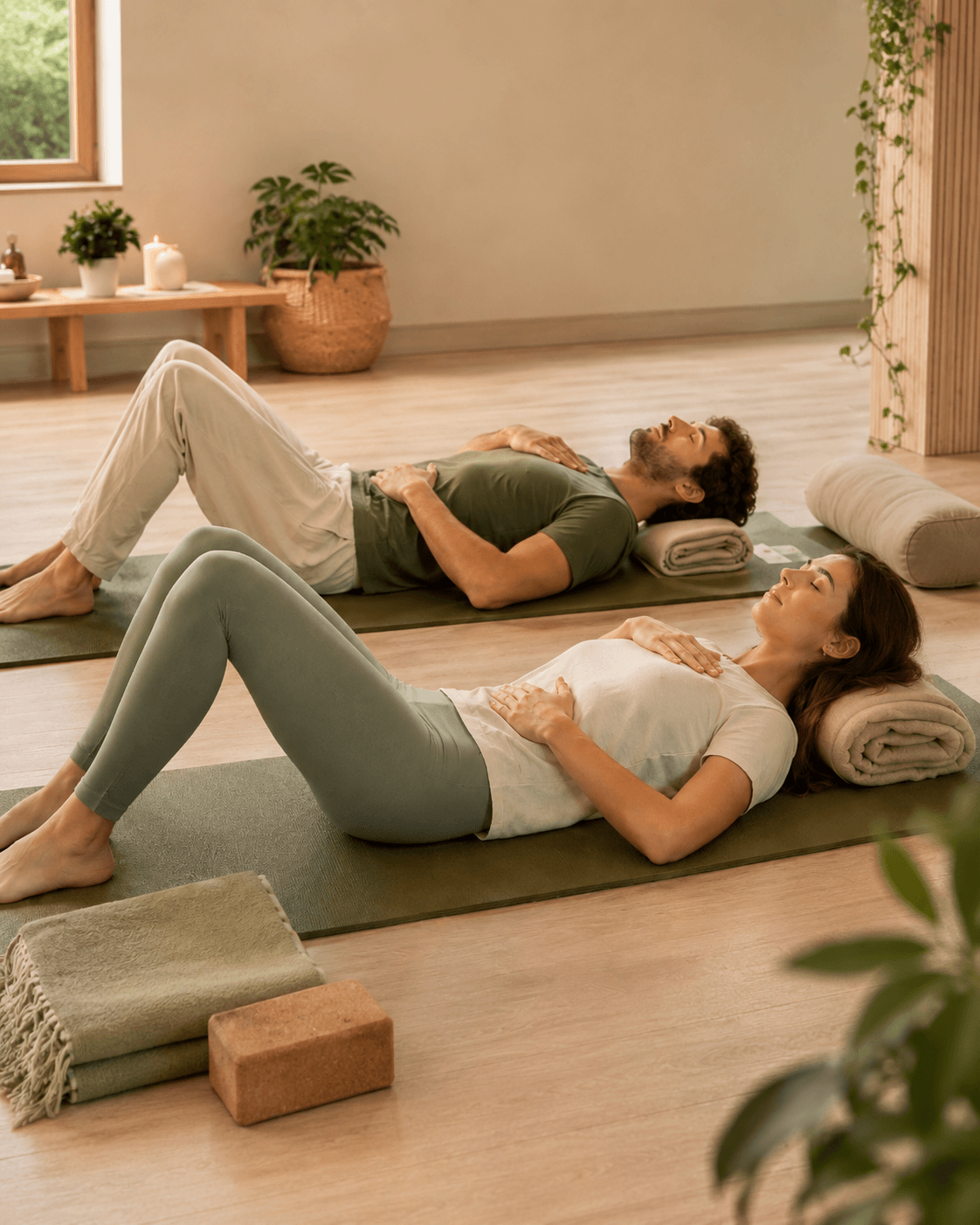
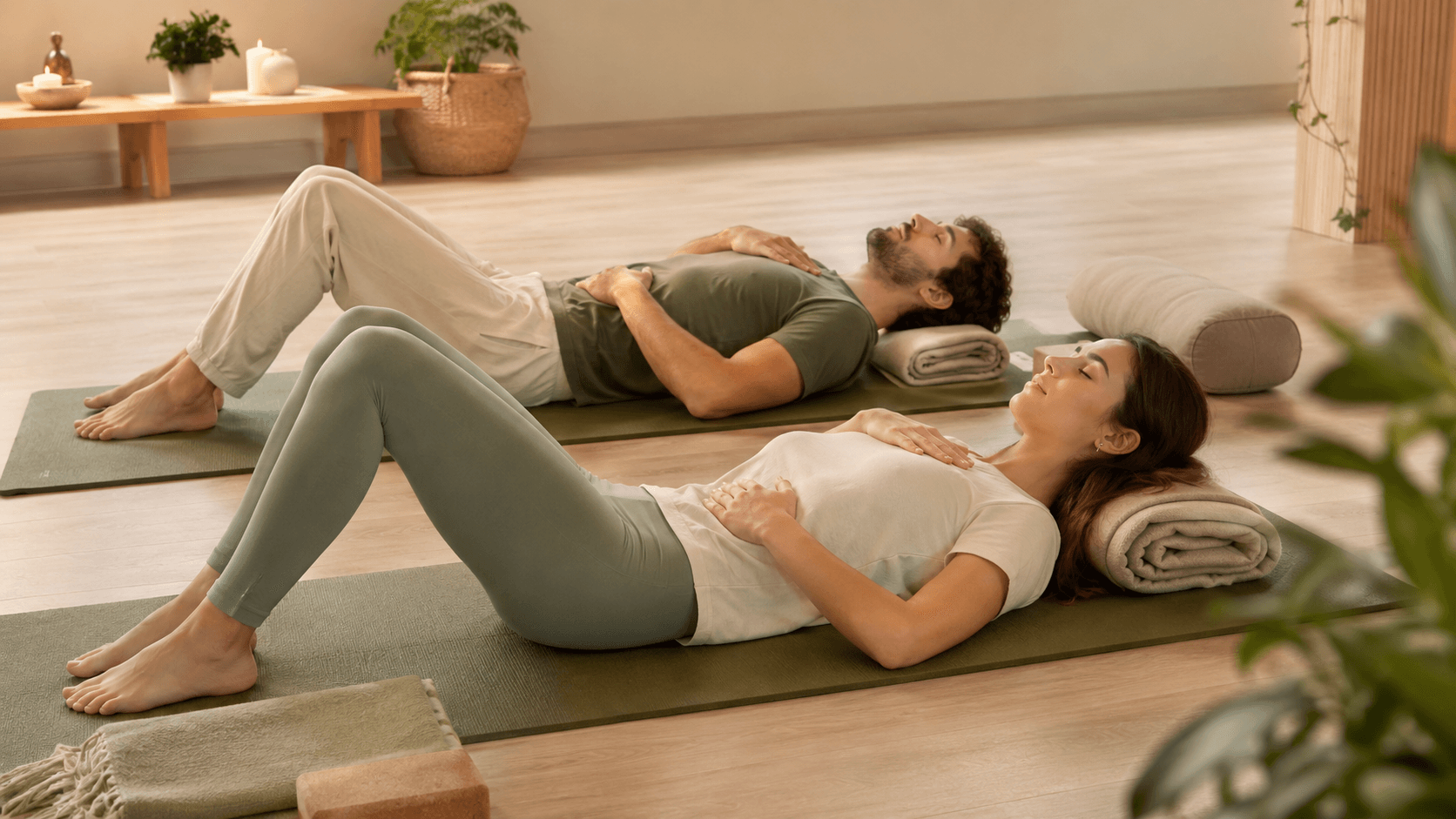
Practice for about 3 minutes. Lie on your back with your knees bent or sit comfortably with your back supported. Place one hand on the upper chest and the other on the lower ribs or abdomen.
- 1. Begin with your natural breathing rhythm.
- 2. Inhale gently through the nose if that feels comfortable.
- 3. Notice whether the lower hand moves slightly.
- 4. Let the ribs or abdomen expand without pushing outward.
- 5. Keep the shoulders soft.
- 6. Exhale without forcing the air out.
- 7. Let the next inhale arrive naturally.
- 8. Continue only while the rhythm feels easy.
3. Soft Longer Exhale
Breathing patterns naturally change throughout the day.
During stress or mental overload, the breath may become faster, shallower, or less regular.
A softer and slightly longer exhale can be a gentle way to experiment with a slower rhythm.
The aim is not to force relaxation. It is simply to create a little more space during the exhale.
Practice for about 2–3 minutes. Sit comfortably or lie down.
- 1. Begin with a few natural breaths.
- 2. Notice the inhale and the exhale without changing them.
- 3. Allow the next exhale to become slightly quieter.
- 4. See whether it can become a little longer than the inhale.
- 5. Avoid rigid counting unless counting genuinely feels helpful.
- 6. Do not hold the breath.
- 7. Let the next inhale arrive naturally.
- 8. Return to your normal rhythm whenever you need to.
A Few Beginner Reminders
Keep your first breathing practices simple:
- Start with two or three minutes
- Keep the breath soft and quiet
- Avoid forceful or dramatic inhales
- Do not try to fill the lungs as much as possible
- Let chest movement happen naturally
- Skip breath-holding when you are starting out
- Adjust or ignore rigid counts
- Stop when something does not feel right
- Choose consistency over intensity
Safety Note
Breathing exercises should not feel like a struggle.
Stop the practice and return to your natural breathing rhythm if you experience:
- dizziness or light-headedness
- discomfort or pain
- unusual shortness of breath
- a strong sense of air hunger
- increased anxiety
Start With One Simple Practice
Breath work does not need to be intense or complicated.
Choose one practice. Try it for a few minutes. Notice how your body responds.
The goal is not to breathe perfectly.
It is to find a gentler and more comfortable place to begin.
Explore further: Breath Work 101: A Beginner's Guide·Common Breath Work Mistakes to Avoid·Breathing Exercises Before Bed·How the Diaphragm Moves Air
Educational Disclaimer
This content is for informational and educational purposes only. It is not intended as medical advice and does not replace professional consultation. Always speak with a qualified healthcare provider before making changes to your health routine.
Sources & Further Reading
- Fincham, G. W., et al. (2023). Effect of breathwork on stress and mental health: A meta-analysis of randomised-controlled trials.
- Zaccaro, A., et al. (2018). How Breath-Control Can Change Your Life: A Systematic Review of Psycho-Physiological Correlates of Slow Breathing.
- Laborde, S., et al. (2022). Research on voluntary slow breathing and vagally mediated heart rate variability.
- Steffen, P. R., et al. (2017). The Impact of Resonance Frequency Breathing on Measures of Heart Rate Variability, Blood Pressure, and Mood.
A Practice to Try
A short guided practice connected to this topic.
Nervous System Reset | Guided Breathwork
Beginner
A guided breathwork practice designed to help you explore short, intentional breathing patterns and return to a calmer state. This practice may support a sense of reset and nervous system awareness.
This practice is for educational purposes only and is not medical advice. If you feel unwell or have a medical condition, consult a qualified healthcare professional before starting any new practice.
Related Reading

Breath Work 101: A Beginner's Guide to Conscious Breathing
Breathing is both automatic and voluntarily adjustable. This beginner's guide explains how gentle breathing practices may support stress regulation, heart rhythm and body awareness — without forcing the breath or chasing a perfect technique.

How the Diaphragm Moves Air: The Mechanics of Respiration
The diaphragm is the primary muscle of inspiration. This guide explains how it changes pressure inside the chest, why the belly may move as you breathe, and how to begin with a gentle, unforced awareness practice.

Breathing Exercises Before Bed: A Gentle Way to Wind Down
A short breathing practice can create a quieter transition between a busy day and bedtime. Learn how to explore gentle breath awareness and a softer exhale without rigid counting, force, or pressure to fall asleep.

Breath Work Mistakes Beginners Often Make
Breath work does not need to feel intense to be useful. Learn nine common beginner mistakes and discover gentler alternatives that prioritize comfort, flexibility, and a more sustainable approach to breathing practice.

Continue exploring
Discover guides, supplements, books, and practical resources for stress & mental balance.